Skip to content
 Home » rc-projects » Bulk WebP Compressor
Bulk WebP Compressor
key links
key info
Project Title
Bulk WebP Compressor
category
Web Development
project status
Completed
Role
Frontend & Performance Architect
Tools & Technologies
React 18, TypeScript, Tailwind CSS, Vite, JSZip, HTML5 Canvas API, FileReader API, Lucide React, Google AI Studio
Timeline
2 Hours
Project Overview
NDT Bulk WebP Compressor is an advanced, client-side bulk operations platform engineered to solve one of the most critical challenges in modern web publishing: media payload size constraints. Built entirely in a sandboxed runtime environment, it eliminates the need for slow, cloud-based server endpoints by executing complex image refactoring and file conversions locally within the user's browser sandbox.
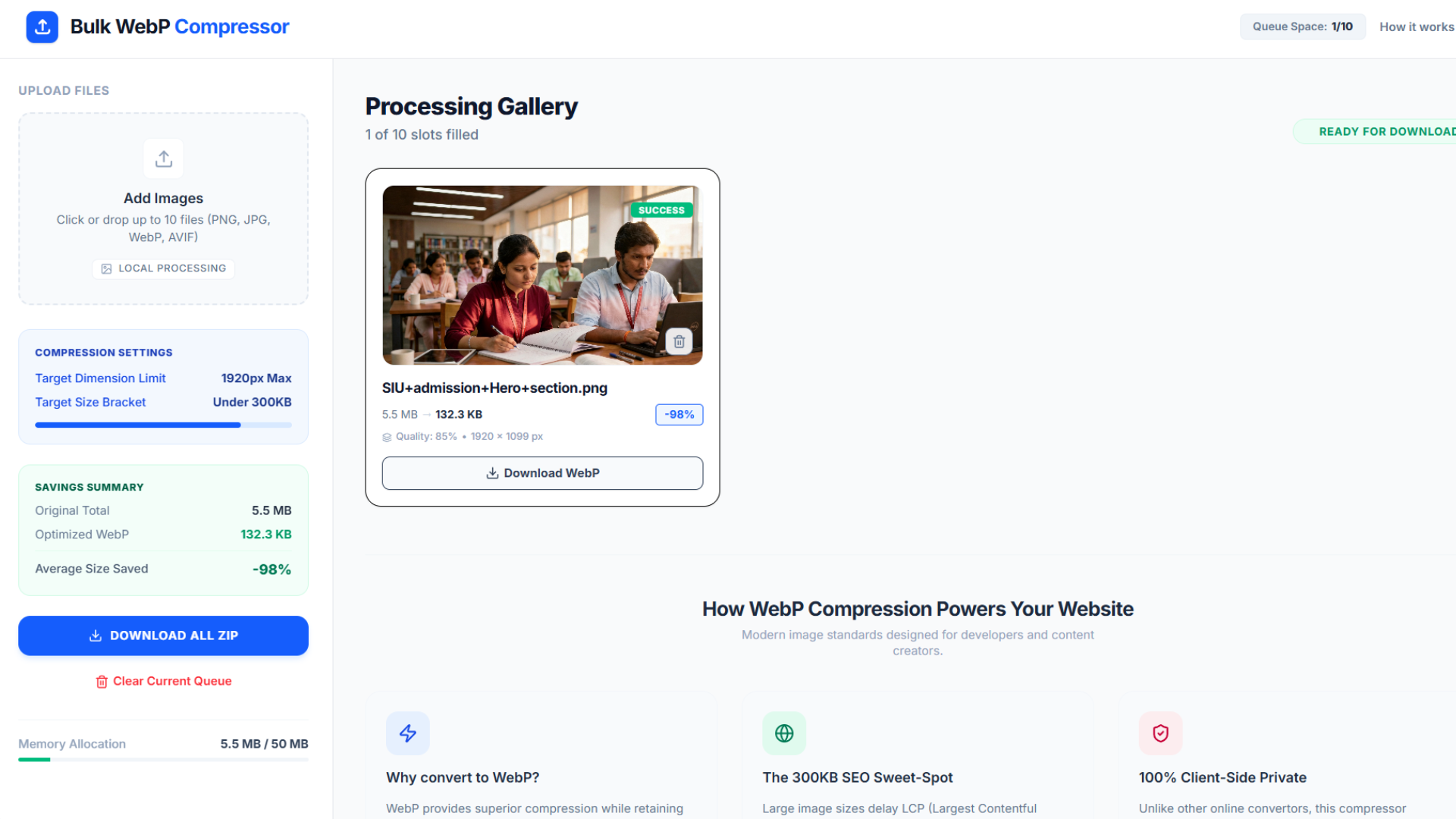
The application leverages a strict "Geometric Balance" viewport layout. The interface splits cleanly between a persistent utility sidebar (housing the local image drag-and-drop dropzone, live system guidelines, and dynamic bulk controls) and an immersive, grid-based processing gallery. This ensures developers and content creators can monitor their media optimization workflow with high structural clarity.
Designed for modern conversion-focused SEO compliance, the application targets a strict 150–200 KB sweet spot standard. By proactively converting media to WebP format, users can guarantee search engine crawler performance and speed up Mobile PageSpeed scores. Since the architecture utilizes standard in-memory drawing buffers, images remain 100% private and never touch an external database or network route.
Challenges Faced
- Strict Size Constraint Guarantees: Compressing ultra-high-definition multi-megabyte source images (PNG, JPEG, AVIF) down to a precise 150-200 KB bracket reliably without introducing severe blocky artifacts or destroying visual details.
- Memory Management & Garbage Collection: Dynamically converting multiple heavy payloads within the DOM without causing client-side memory leaks or freezing browser paint operations during heavy zip compiles.
- Responsive Sidebar Density Mapping: Formatting standard tabular summary calculations, bulk CTA elements, and input modules in a clean 320px column layout without triggering horizontal clipping.
Solutions Implemented
- Two-Phase Adaptive Reduction Pipeline: Configured a smart fallback mechanism. The engine first reduces file sizes by stepping down quality weights (85% down to 45%). If files remains over the 150-200 KB limit, they under-go a progressive dimension resize down to 30%, maintaining aspect ratio bounds.
- Object URL Garbage Disposal Loops: Structured clean React useEffect lifecycles that actively trigger URL.revokeObjectURL on component unmount and queue clears, releasing raw host memory buffers.
- Divided React Layout Contexts: Segmented the calculation threads and bulk utilities into distinct, decoupled components (ActionBar, ResultsGrid, ImageCard, UploadDropzone), maintaining a highly legible, modular codebase.
media gallery